
How You Can Tell If a Valentino Garavani Bag Is Real
Authentication is an ordered routine, not a glance, and the sequence you follow matters more than most guides let on. You may burn twenty minutes on the stitching only to realise that the company you think you are buying from never made the bag, which is exactly what happens when the steps run out of order. The steps below is meant for someone holding a bag or reading a detailed listing, and each step does one job before handing over to the next. Before you begin, two warnings. The kind of date-code system some buyers expect simply does not exist here, and plenty of details passed around as decisive proof settle nothing, which is why each step marks the edge of what it proves. On a high-value purchase, nothing here stands in for a professional authentication service; the steps below simply tell you when to pay for one.
Step 1. Identify the maker before anything else
This one leads because a mistake here cancels out everything downstream. The Valentino name covers two unrelated companies: the Rome couture house founded in 1960, whose leather goods are stamped VALENTINO GARAVANI, and Mario Valentino S.p.A., a leather goods and footwear house founded in Naples in 1952, which sells as Valentino by Mario Valentino. Under a 1979 coexistence agreement, the couture house is contractually required to use GARAVANI alongside VALENTINO on leather goods and their advertising, which is why that second word appears at all. A Mario Valentino bag can fail every other check on this list and still be entirely authentic, and the mis-selling runs both ways. So start with the branding and settle which company you are dealing with before the question of real or fake even comes up. If the outside says only Valentino and the inside says Mario Valentino, valentino garavani mini bag what you have is an authentic bag from the Naples company, not a fake valentino garavani bag.
Step 2. Give the interior tag a word-by-word reading
Of all the checks, the interior tag pays best, and it rewards patience. Expect a genuine piece to show VALENTINO and GARAVANI in capitals alongside MADE IN ITALY, because the brand’s own product pages state Italian manufacture. Study how the tag is fixed before you read a word of it: stitched down on all four sides, lying flat, no loose corner, no glue. The lettering comes next: font weight should be consistent across every character, and the impression should be even, not blurred, doubled or patchy in depth. Because counterfeit tags often get the words right and the pressure wrong, the stamp’s physical quality is as important as the wording. Where the tag is absent, or shows only one of the two words, should be treated as a serious concern.
Step 3. Treat serial numbers as evidence, and forget date codes
Serial numbers are real, normally on a tag inside an interior pocket, frequently black, cream or light brown. Shoot it and compare: it should be stamped as cleanly as the main interior tag. What catches people out is this: the serial is not universal across the house, and older models may never have had one in the first place. A missing serial does not prove a bag is fake, and anyone who says otherwise is oversimplifying; and its presence proves little either, given how easily numbers are copied. Note too that this house runs no date-code system of the kind used elsewhere, so there is no stamped string decoding to a factory and a week of production. Any listing quoting you a date code tells you the seller is describing another brand or inventing reassurance, and both readings are reasons to slow down. Treat related folklore the same way: the claim that a lining colour proves authenticity is not verified and should never be decisive.
Step 4. The authenticity card, and what it is worth
Cards are reported to come with these bags, bearing model specification, a serial number and a Made in Italy line agreeing with the interior tag. That description comes out of resale and authentication guides, rather than an official statement by the house, so treat it as market practice. If a card is present, agreement is the test that matters: the number printed on the card should match the one inside the bag, and any mismatch is a genuine red flag. The absence of a card supports no conclusion, since pre-owned bags often arrive without one after years of ownership and resale. Sellers do sometimes sell the card as a certificate of authenticity, but it is not one, and cards are copied as easily as tags. The card is worth only what it corroborates, and not at all for merely existing.
Step 5. Inspect the hardware and its engraving
Since engraving costs real money and printing does not, the hardware is where counterfeit economics surface. On genuine pieces logos are engraved rather than printed, with depth you can feel with a fingernail and edges that remain sharp when magnified. Observed zip pulls on the line are square with rounded edges, carry the same deep engraving, and ought to have real weight rather than feeling hollow. The tone of the metal is restrained, not brassy, and the observed finishes include antique-brass, light gold and platinum, so loud yellow gold is worth questioning. Check that every piece of hardware matches every other in tone and finish, since separately sourced parts are where mismatches appear. Keep in mind that the finishes are plated, which matters for how you care for the bag.
Step 6. Studs first, stitching second
When a stud is the house signature, the studs themselves make a legitimate test. Height, facet angle and flat top should be identical from pyramid to pyramid, and none of them should wobble, spin or stand proud of the leather. The other half of the test is spacing, because even spacing along a strap or flap edge is hard to fake at volume and easy to check by eye. Move on to the stitching next, which should be regular in length, aligned to the seams and even in density across panels. Wandering stitch lines, loose threads and shifts in tension along a single seam are some of the most reliable signs of a counterfeit, because they are the hardest details to industrialise cheaply. Spend time on an edge that runs the full length of the bag, which is where inconsistency shows.
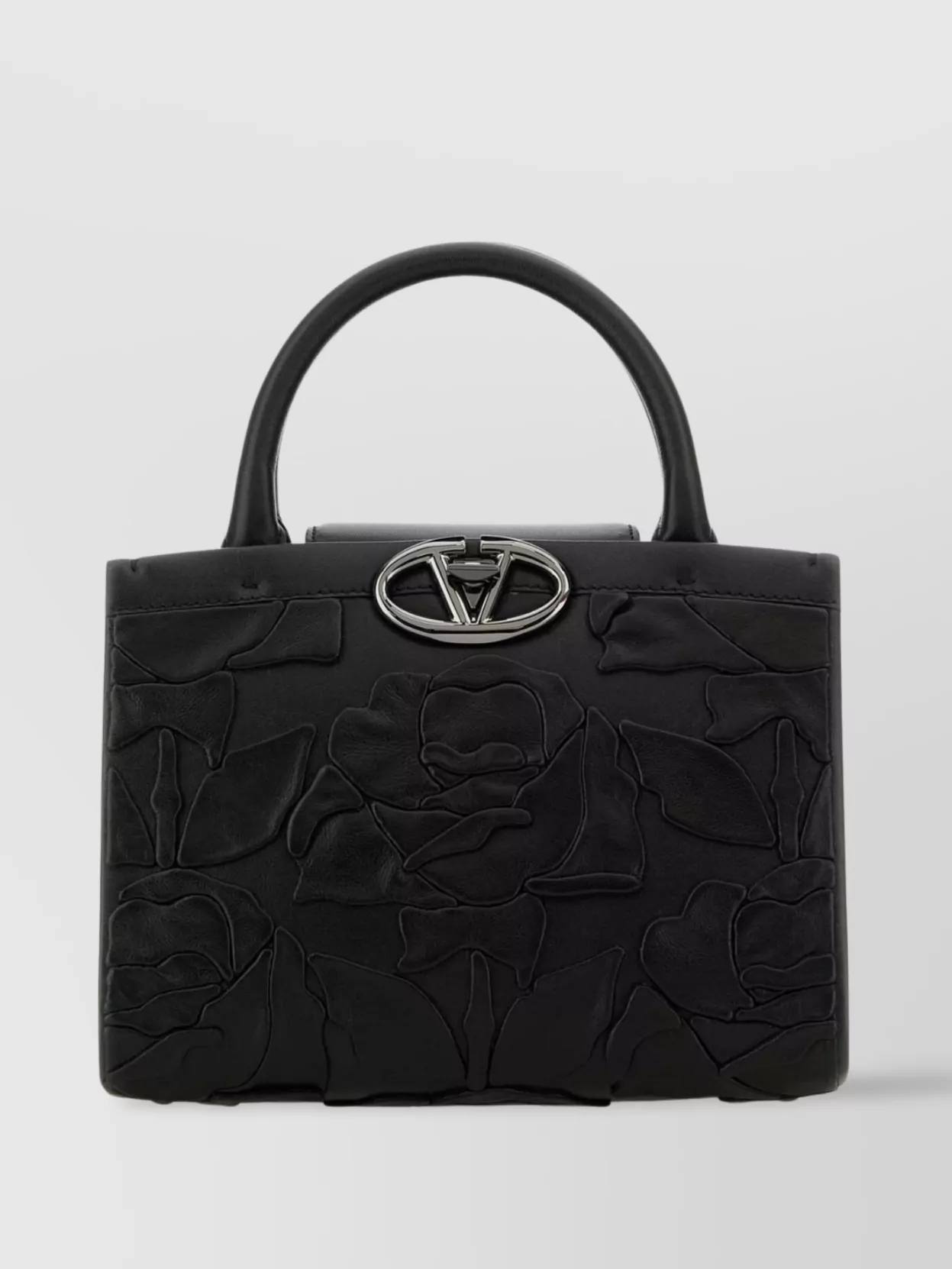
Step 7. Run the price check and weigh the seller
Price is a check rather than a courtesy, and it catches the listings that pass every physical test in photographs. Compare the asking price with observed 2026 market prices on the brand’s own United States site: Rockstud runs $1,250 to $2,100, Rockstud Spike $2,400 to $3,700, Locò $2,700 to $5,900, VSling $3,350 to $6,550 and VLogo Signature $650 to $3,750. Pre-owned, the numbers matter too: observed retention on one major platform sits near 41 per cent of retail, with motif styles around 50 to 58 per cent, which means a used valentino shoulder bag offered at a tenth of retail is telling you something. Then judge the seller as hard as you judged the bag: the brand’s own boutiques and its webstore, or named authorised retailers such as Neiman Marcus, Bergdorf Goodman, Saks Fifth Avenue, Mytheresa, Net-a-Porter and Farfetch. Among resellers, Fashionphile, The RealReal, Rebag, Vestiaire Collective, Collector Square and 1stDibs are established platforms authenticating in-house before they list. If the bag passes but seller and price both look wrong, walk away and buy the same model somewhere accountable.
The checklist in brief
The table summarises; it does not replace the steps above, since the third column is where buyers usually slip. Several of these checks carry weight when they fail and very little when they pass, an asymmetry worth committing to memory. No interior tag is damning; one that is there is merely encouraging. A mismatch in the serial is damning; the absence of a serial means very little. Leave the order as it is, because establishing the maker first saves you from a checklist that cannot apply. If two or more rows come back negative, stop there and pay for a professional opinion.
| The item you check | What the real thing looks like | What failure actually proves |
|---|---|---|
| Maker identity | VALENTINO GARAVANI stamped on the leather goods | Valentino alone on the outside and Mario Valentino inside points to a different, authentic company |
| The tag within | VALENTINO and GARAVANI in capitals alongside MADE IN ITALY, four sides sewn | A tag that is missing, or carries only one word, is a serious concern |
| Serial numbering | Typically on a tag within an interior pocket, with clean stamping | Absence on its own proves nothing, and older models may never have had one |
| Date codes | There is no date code, since the house operates no date-code system | Quote a date code and the seller is describing another brand |
| Authenticity card, if any | By report, it lists model, serial and Made in Italy to match the tag | Bags bought pre-owned often come without one, making absence normal |
| Hardware | Engraved not printed, the cut deep and even, the tone restrained | A printed, shallow or smudged logo is a strong negative |
| The studs and the stitching | Even pyramids, even spacing, aligned seams, steady stitch density | Any wobble, spacing irregularity or wandering seam is a strong negative |